Monday, August 10, 2015

Huevos and Pink Potatoes


Do you remember those beautiful potato plants I was bragging about?  The ones Jamie and I planted in the dirt that was given to me by a friend?  My first potatoes?  Before we left for our Peru adventures, these were substantial plants.  The leaves had some tiny holes due to a flea beetle infestation, but they were still a good looking mini crop.  Well, look at what I came home from Peru to find!  All dead!!  Nothing but weeds and limp potato stems.  What happened?  


Jamie and I decided to salvage what we could, and dig up the potatoes, if there were any.  This teeny potato is the first one we found.  Pathetic.  I'm a potato farmer failure!


But, undeterred by the disappointing size of the first potato excavated, Jamie kept digging and found some potatoes of a respectable size.   


Hey, that one looks big enough to brag about!  


We tossed the dead stems to the side so Mrs. Hall could search for worms in soil clinging to the roots.  It was interesting to see the tiny potatoes clinging to the stem near the soil surface.  If the plants hadn't died, they would have made many more potatoes.


We washed our harvest in the garden hose, and were surprised to see that the potatoes were pink!  How cute!  I think they are new potatoes, and weren't mature enough to develop the brown skin I was expecting.  


Not an overly impressive harvest I guess, but considering it was only eight dead plants in a small bed, I think we did okay.  


I was out of town for several weeks for work, so I didn't get to eat any of our pink spuds until recently.  Look how nice they look on the inside!  Just like a real potato, right?  


How best to perform my first taste test?  Cooked in butter, of course!  Delicious.


Since I hadn't been grocery shopping for weeks, it was slim pickings around our place when we got back from our vacation and work adventures.  Fortunately, June's work ethic is solid, and she never stopped laying eggs even though I wasn't there to encourage her.  And the bowls of pink potatoes waited patiently.  Potatoes and eggs have were the featured items on our menu for several days.  I perfected what I call "huevos and potatoes"- potatoes and vegetables cooked in butter, and then a few eggs fried in the middle of the pile.   I didn't get any complaints or offers to pick up take out even after serving huevos and potatoes for several nights in a row.  


Potatoes, even when they die early from an un-diagnosed condition, were still worth the little effort it took to grow them.  I may have to add them to my garden again next year.  Just imagine how good they would be if I manage to keep them alive!

Tuesday, August 4, 2015

Catching Bats, Flying Squirrels, Owls, Birds, and Frogs


Hello!  I know it probably doesn't feel the same to you, but to me it seems like we haven't chatted in ages. How are you? Brandon and I spent the last three weeks out of town conducting surveys for endangered bats.  I've told you about it before, I'm sure, but it's always different each year since we rarely go back to the same places.  We spent the most time in northern Ohio, and the photo above is from our very last survey location, near a nice pond which a beautiful sunset and glowing clouds.  This wasn't the only picturesque thing we saw, since there were lovely farms in the area, but since we spent most of our time working in the dark forests, most of my photo are of animals I managed to get in hand or in my nets.  


Being an fan of animals, as I am, I was frequently entertained.  I really like this photo that Brandon took of a big brown bat (Eptesicus fuscus).  Bat photography is challenging since it's dark, our headlamps are either too bright or too dim, and bats are wiggly.  But this photo really captured the intricate veins in the wing membrane, and the texture of the fur.  


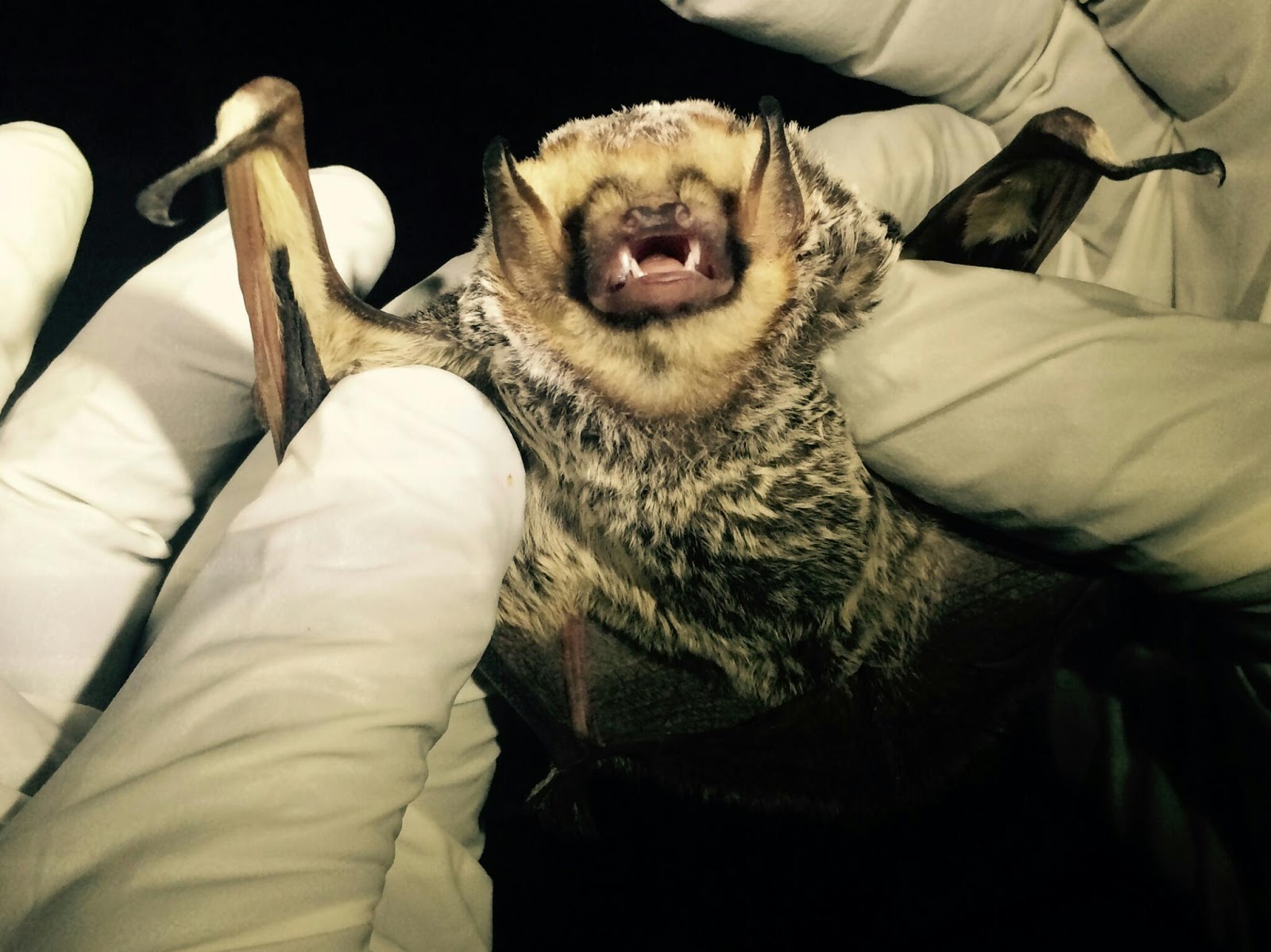
And, we caught two hoary bats (Lasiurus cinereus) this summer.  This isn't a species I've caught very often, and these were first one's Brandon had ever seen, so we were quite excited when we saw them in our nets.  These are really big bats, as far as bats go, and have a beautiful gold, black, and silver pattern in their fur and on their faces.  


You can see how frosted the tips of the fur are in this photo, where the hoary bat is dangling from my glove.


At one of our survey sites, we had three young flying squirrels who were fascinated by our nets, and they had fun driving me crazy by chewing holes in the nets and climbing on the poles that hold the nets in the air.  One of our nets was placed over a shallow pool way back in the woods, with about six inches of water over eight inches of mud.  I was reaching a big stick to the top of the net, trying to entice the flying squirrel onto the stick and out of my net, when my headlamp fell off the back of my head into the water and mud behind me.  Total creepy darkness!  I groped around in the mud for a while, getting all wet and dirty, and finally had to yell for Brandon to come with a light.  


It's a good thing they are adorable!


Someone told me once that they were little devils in a cute suit.


We even caught two screech owls.  Brandon yelled from one of the nets that I should come with my thick gloves.  He said "we've caught... something... a bird or something..."  Ha!  It did look like a bundle of feathers with a giant eye!  I didn't have to use my gloves though.  As soon as I opened the net, he stretched his wings, looked around with his giant eyes, and flew off through the big hole he made with his claws.  Whew.  I'm glad that was easy.


Now that I'm comfortably settled in an air conditioned and parasitic insect-free room, I can look back at my photos and enjoy the memories of the cool bats and other critters we met on this adventure, but it's probably best that I didn't have time for blog posts while we were there, or you would have read weeks worth of complaining!  The mosquitoes were a nightmare!  Biblical even, or maybe I should say apocalyptic.  Whatever word is the worst, that what these mosquitoes were.  They were so bad that we had to wear nets over our faces to keep them from going in our eyes, ears, and mouths.  The buzzing was maddening.  Even with nets over our faces, they would sit on the outside of the nets trying to drink our blood.  Hundreds of them, in swarms around our bodies. It was like nothing I've experienced before.  Even though I was so hot that sweat was dripping from the cuffs of my rain coat, I wore it anyway, just to keep them from biting me.  They could bite through most clothes! This is the first time I ever got mosquito bites on the palms of my hands.  I tried to keep my gloves on as much as possible because I must wear off the bug spray quickly on my hands.  I don't usually poison myself with Deet, but I just had to use it here.  It was horrible.  So HORRIBLE!!!  I've been traumatized.  


We did catch some northern long-eared bats (Myotis septentrionalis), which are a federally threatened species now that their populations have plummeted due to a deadly fungus that has infected the caves they hibernate in.  These are small bats with big expressive ears.  We glued tiny transmitters, like the one in the photo, which is attached to a tricolor bat (Perimyotis subflavus), to their backs, and spent the days using a receiver and antenna to find the trees they roost in during the daylight hours.  Then, in the evening, we would watch the roost trees and count the number of bats that emerged.  Not very many were counted.  This used to be one of most common type of bat we would catch, but now there aren't many left. 


Ornithologists use the same type of nets that we use to catch bats, to catch birds.  I try to raise my nets after the birds have gone to bed so I don't have the challenge of untangling them, but every once in a while I catch someone who stayed up late, like this Arcadian flycatcher (Empidonax virescens).  


We didn't catch any frogs in our nets, but we did have several frog encounters, including this tiny wood frog.  I enjoyed the bats, flying squirrels, owls, birds, and frogs, but I'm glad to be home.  I'm glad to be away from those mosquitoes! 

Friday, July 17, 2015

Painted Floor


I keep telling myself that I'm going to continue to tell the story of our trip to Peru, including our time in Cusco during the summer solstice festivities, the beautiful hikes to Inca ruins and wild rivers in Ollantaytambo (including a  near encounter with a bucking bull), and I want to post the pictures of the neat hostel in Aquas Calientes and the guinea pig we ate at our farewell meal, but right now, all I can think about are these photos Brandon sent me yesterday, of the newly painted floor at the farm house.  Wow.  The floors are so shiny and clean! 


I've been working in the field for the past few days, collecting mosquito bites and chiggers in the weeds and forests, but Brandon has been sanding, cleaning, and painting the wood floors at the farm, and sending me photo updates of his progress.  I can't wait to walk on these floors.


Having the floors all the same clean color really makes the house look like it's almost finished, and ready for us to move in.  We've been working hard to get it painted before the weekend, since we expect to be sent away for some out of town bat surveys any day now.  We can't walk on the floors for several days while the paint cures, so it makes sense to do this work before we leave.  


The original wood floors in the house are crooked and have many places that were rotten and that we patched, so having everything the same color is a big improvement.  The kitchen floor, which is new plywood, got some wood putty in the seams, and the same color of floor paint as the rest of the house. Brandon also repainted the floor in the downstairs bedroom, since he didn't like the marigold color I selected originally.  I like this dark chocolate color too, which is a good thing, because after Brandon worked so hard to get everything painted, he asked me not to tell him if I didn't like it.  Ha!  I vacuumed and mopped the upstairs floor the last time I was there, so I don't have to imagine how much work it takes just to get rid of two years worth of construction dirt.  We will not be cutting any more wood inside the house from here on.   


Brandon must have taken this picture right before he closed the door on the wet paint.  I think the dark color makes the kitchen look smaller.  


It looks pretty good upstairs too.  I think it's time to start packing for the move!

Friday, July 10, 2015

Inca Trail, Day 4 - We Arrive at Machu Picchu!


The final day of the hike- Machu Picchu!  I want to say that Machu Picchu was a little anti-climatic, but that doesn't really explain how I feel about it, because it's... well, it's Machu Picchu for goodness sake!  How could that be anti-climatic?  I think what I really felt was that the hike itself was the Big Deal, and ending a Machu Picchu, after days of spectacular views and impressive Inca ruins, was perfectly fitting.  It wasn't a momentous Aha! moment, even though it was our final destination, but that might have been because by that point in the hike, our knees were sore, our camera memory sticks were brimming, and we had been up since three in the morning.  No joke.  Three o'clock A.M.  Hiking.  In the dark.  


The brochures and guides like to imply that the reason the last day starts so early is so that we could arrive at the famous Sun Gate to see... the sun... or something.  I never was sure exactly what the pay off was going to be.  I think in reality, the porters have to catch the five A.M. train home, so they wake us up at three, hand us a breakfast biscuit and some snacks, and start taking down the tents before we've fully emerged.  


We had a short walk to the official check-in point, where we had to wait on a bench until five-thirty A.M. so we could sign in and begin the last leg of our hike.  Other groups straggled in behind us, and we all waited together.  While waiting, we noticed the little guy in the photo above - a scorpion!  I was very grateful that I didn't see a scorpion until I was finished sleeping on the ground!


One of our group used his phone each day to keep track of our hiking distance and elevation.  No wonder Day 2 was so hard!  But look at the end of the graph, on Day 4.  See that steep climb?  I believe that is the section referred to as the gringo killer staircase.  No one warned me about that until we were there.  It was an ascent that required both hands.  


Once we got through the check-in point, we had a fast hike in the dark, which despite the previous nights warning about four-thousand foot killer drops, was conducted at a breakneck speed.  Our group kept the lead for a while, and despite the race, I enjoyed the darkness and the sounds of insect and frogs, which gave way to the sound of birds waking up the sun.  


We had a short break at the sun gate, with our first early morning views of Machu Picchu, and then we watched the sunlight creep down the mountains toward the ruins while we hiked toward them.  


You can't tell from these photos, but there is a crowd of people standing around me.  As soon as we neared the ruins, we were mixed with the crowds of tourists who come to see the archaeological wonder by train and bus.  


Our guide lead us to a sunny terrace, and gave a short lecture about the site.  Unfortunately, we were exhausted and the sun was too hot, so it was hard to focus.  About half way through the talk I realized there were multiple wasp nests in the wall the group was leaning against, so I spent most of the time watching giant black wasps inches from everyone's head and worrying about stings.  I was relieved when he was finished and it was time to explore the ruins.  


This temple was built into the natural rock formations on the mountain.  It was pointed out to us that there is a difference in the stonework for temples and other important buildings.  The terraces and normal structures are built from stone but it looks more rustic, and uses some mortar.  The temples and religious sites are made with stone on stone, no mortar, and with very smooth edges.  


You can see the smooth stone work of the rounded temple in the background on the left, which contrasts with the rustic stone work in the foreground.


I believe we were told that the soil that fills the garden terraces was brought in from another location by the Inca.  We saw some active archaeological excavations while we were there, and it appeared that they were removing the soil from the terraces an inch at a time, and finding bits of pottery and other artifacts buried in the soil.  


Even the main doorway to the temples was made from the smoothly carved stones.


At the top most temple was this stone carved to mimic the mountains in the distance.  


This is the stone sun dial that's reported to give off a palpable energy to those that can feel it with their outstretched hands.  I didn't feel anything, but I think my vibe was getting hijacked by the guard who was smirking at me while I tried to get in tune with the stone. The man, keeping me down, right?  


See those stone projections on the side of this house without a roof?  We saw some re-created houses with thatched roofs and could see how those projections were used to tie the roof on with straps.  


I've already forgotten the name of this temple, but it was something to do with a condor.  See how the head and beak of the bird are on the ground, and the natural stones are like outstretched wings?  

Is wasn't long after noon before we were sun baked and ready to head down the mountain to find our hostel, a shower, and a nap.  We did it!  


Related Posts Plugin for WordPress, Blogger...