Tuesday, June 9, 2015

Stacks of Honey!


Look at those bricks of beautiful gold!  We harvested an entire small super of honey from the hive by the garden last Friday.  I'm so impressed with these bees.  They managed to fill an entire super of honey for us, and send out a new swarm in the same spring season.  


Before I got to the well established hive with the honey, I checked our captured swarm to see how they were doing.  The photo above shows all the yellowish brood cells that are capped with baby bees inside.  The white cells are capped over honey.  These bees are a growing family.  Almost all the frames in this one super has some honey and some brood.  They were so full, that dad had to go to the farm and garden store to buy a new super so we could add a second story to their home.  


Here's a close up of the brood cells that aren't capped yet.  See the white wormy looking things - I hesitate to call them maggots, since maggots are gross - in the bottom of the cells?  Little bee babies all curled up.  Okay, they look like maggots, but I was still excited to see them.    


I'm pretty sure that big bee on the top left is a drone.  The drones are the males, who don't do any work, but are just there to mate with new queens.  I think the drones don't have stingers, so they are okay to pick up and handle bare handed.  I could tell he was much larger than the other bees, but I wasn't quite confident enough to pick him up without my gloves.  Maybe next time.  


This is the hive that I took the honey from.  For some reason, we didn't fill the super with enough frames, so the two spaces on the right are just the wax and honey that the bees made, without the guidance of the frame.  It really goes to show how the supers and frames are set up to create the perfect width of honeycomb and gap between.  It's exactly how the bees do it if left to their own design.  


Because this super was completely full of capped over honey, I wanted to harvest it all, so when it came time to pull the combs that weren't hanging on frames, I just had to pull it out by the clump.  The problem with this is that there was honey oozing from the edges, and when I brushed the bees from the clumps, lots of bees got coated in honey and dozens of them drowned in it.  I can see how the frames are much better for the bee keeper and the bees.  I'm not sure if it's normal to kill that many bees when harvesting.  


I've read that a small super of honey can weigh up to forty pounds.  I believe it!  I held each frame over the hive as I pulled it from the super, and used a small brush to brush away the bees before I added the frame to my stack.  By the time I did seven frames, my arms were shaking.  My left arm and shoulder were sore for days after this job.  I had no idea I was such a wimp!


If I can remember correctly, this is our third year with honey bees.  I felt like this was the first time I opened the hive and didn't feel anxious.  I was actually calm enough while working with the frames and brushing away the bees, that I got into the groove and really enjoyed them.  I had bees buzzing on my veil, and thousands of bees coating the outside of the hive I was working in, which was inches from my legs and feet, and I didn't have that hurry-up feeling that I usually get when opening the hive.  The bees were cool, so I kept my cool.  It was cool.  


Mom used a knife to cut the comb from the frames. If we had an extractor, we could just cut off the caps, extract the honey from the comb, and give the empty comb back to the bees so they don't have to recreate it.  


Just like last time, we squished the honeycomb with our hands in a metal strainer basket, and collected the honey in a crock.  


This is the part that took so long. We had enough honey that we had to empty our crock and then squish some more.  


Everything was a sticky mess - the kitchen, the door knobs, the floor, our clothes.  We decided that the next time we would put the frames in a big plastic tub, so the frames didn't drip on everything while they were waiting their turn to be squished.  


We dipped the honey through another strainer before we poured it into jars.  It's so perfect!  It amazes me that there are boxes of honey out in the garden that we can just go out and collect.  


We put some of the honey comb in some of our wide mouthed jars, just because it looked so neat.  


I'm not sure how many jars of honey we ended up with since my nieces did the counting and their system seemed a little unreliable to me, but one of the numbers I heard was twenty-nine.  Wow.  That is something to grin about, for sure.    

Monday, June 8, 2015

Peony, Pea, and Potato


I can't believe peony season is already over!  Brandon asked me once why I don't plant something that has flowers all the time.  Doh! I wonder why I never thought of that?!  It just doesn't work that way though, does it?  I always have some blooms somewhere to admire, but most blooms are ephemeral, and need to be appreciated during their short display.  


But this pretty blossom will endure here.  I've been so busy lately that it feels like I only had a few minutes with my peony flower friends before they shed their petals.  


I didn't cut a single stem for a vase, or collect a single petal to dry.  


But for a few days, my heart would lift when I pulled in the driveway, because giant pink blossoms were there to great me.  Thank you, whoever you are, for planting these peonies for me to enjoy.  I hope the next person to live in this house enjoys them as much as I have.  


I didn't forget my iris's, even though they may have thought I did, since I didn't cut the old blooms, or weed them, or water them.  This year, as we close in on the farm house renovations, and turn our thoughts and energies to our future there, lots of things have been asked to take care of themselves.  Everyone seems happy to do their blooming without assistance from me.  


Even my chiming rose has finished blooming.  


But the yellow sundrops are still making a daily display.  


The purple clematis I planted on the front fence, which limped along for several years, has finally decided to put on a show.  I'm glad it is big enough now to cover the post I backed into with a work truck last year and bent.  Oops.  If only I could plant flowers on the tail gate of the truck to cover up the big dent...


Mrs. Hall and June get to see the old trusty purple clematis that grows on the corner of the house in the back yard.  This one never fails to impress me on my way to visit the peas.


So many peas this year!


Have you ever watched a pea flower become a pea pod?  Here it goes...


See the baby pea pod poking it's way from under the old flower petal?  


Here's one with the flower petal is dangling from the end of the pod.  At this size, the whole pod is crunchy and delicious.


Now it's a grown up pea pod, and the dried up bit of flower petal is dangling from the tip.  


Inside this womb pod are the eggs peas!  When they are tiny like the ones at the top, they taste like candy.  The larger peas on the bottom taste more like peas, but still tasty.  


June was impressed with the size of my first harvest even though she doesn't really like peas.  


I never realized how cool potato flowers look.  Purple and orange!  Wait, what's that little black speck on the top leaf?  Is that a flea beetle?!


Oh no!  Look at all of them!  I can see at least six in just this photo.  Ah!  And look at all those tiny holes in the leaves.  Jerks.  


I tried spraying the potato plants with some soapy water, but couldn't tell that it helped much.  Everyone on the inter web said to use diatomaceous earth to battle flea beetles without using pesticide.  


Jamie and I drove past a farm and garden store on one of our travel work days, so I bought a small bag of diatomaceous earth, which looks like white chalk dust.  I sprinkled it on the leaves. It rained and washed it all off.  I sprinkled some more.  It rained again.  I sprinkled even more.  I put so much on this last time, that the plants are white!  I still see lots of flea beetles.  It rained again today.  I would sigh if I wasn't so glad for the moisture.  The garden has been so dry.  Flea beetles must like dry weather.  It's a good thing I have a whole bag of the diatomaceous earth.  

Friday, June 5, 2015

Sand Gap Trail to Natural Bridge


Wow!  It's a natural bridge!  Our last long hike (more than 10 miles!) was on Sand Gap trial that leads to the Natural Bridge at the Red River Gorge and Natural Bridge State Park.  The Natural Bridge is almost seventy feet high, but only twenty feet across.  I've heard that the bridge is over a million years old.  I feel safe walking under and on it, knowing it's been around so long and is still looking strong.  


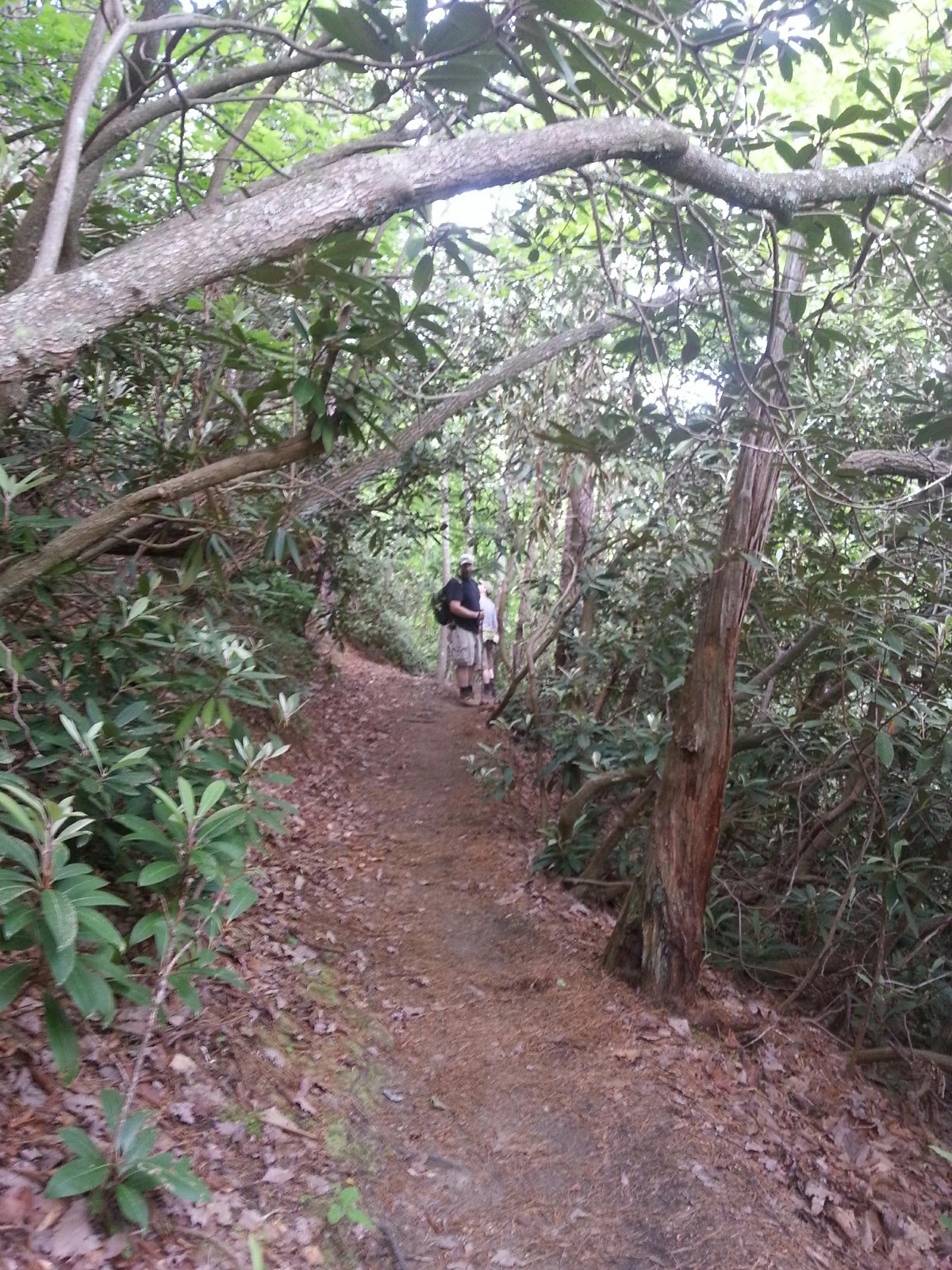
The trail itself wasn't very hard to hike, and parts of the trail were lined with the dense evergreen leaves of the rhododendron, and the they were in full bloom.    Weren't we lucky to get to see all those blooms?


Some of it was so tall, it made a tunnel to walk through.  


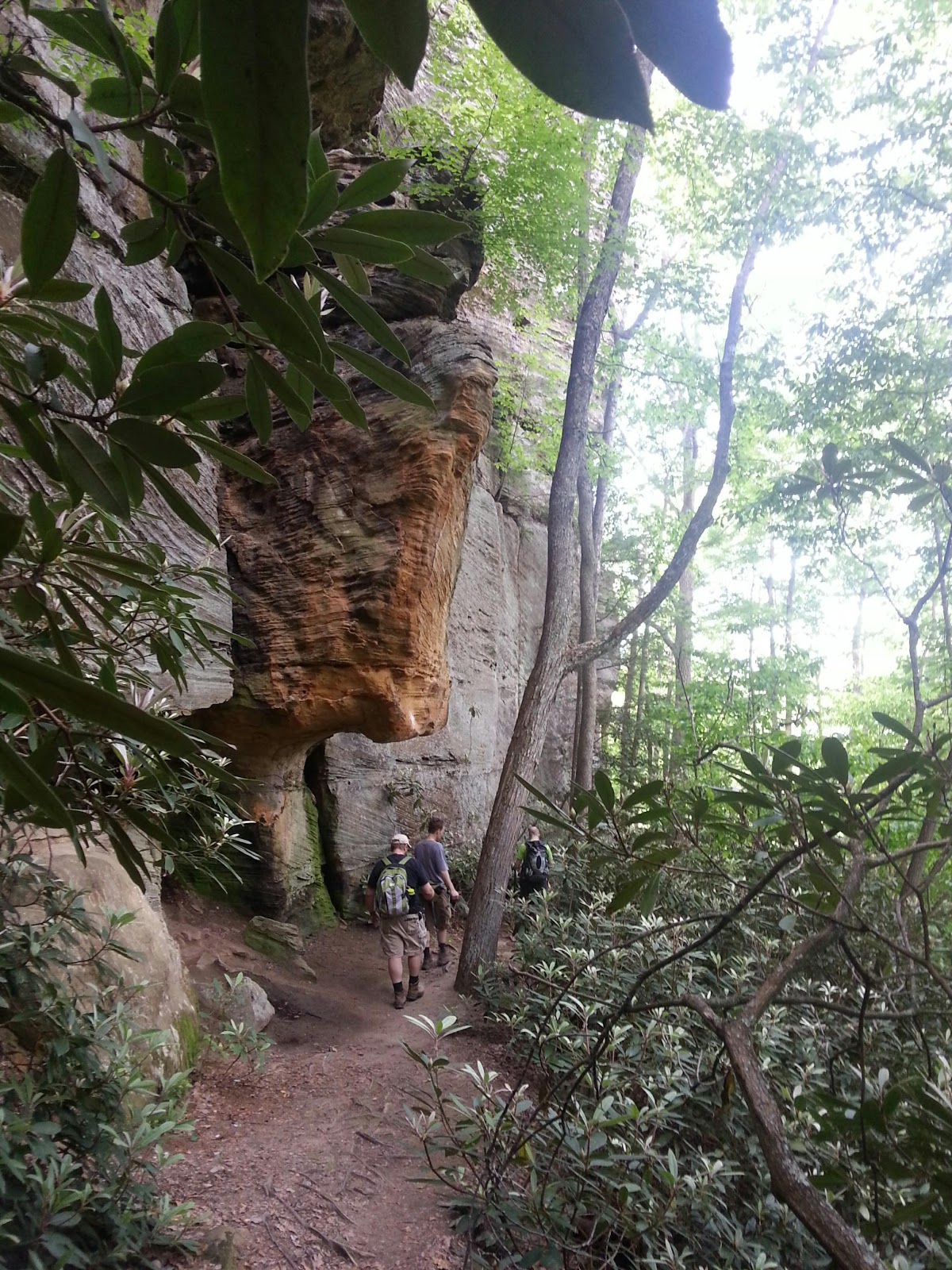
Check out that giant red sand stone.  


Cool rocks, rock.  


This rock with twisting veins of minerals really brought home the reason they are called veins.  Look at that twisty one on the right.  I tried to ask Wikipedia how veins are formed, and was told "When the confining pressure is too great, or when brittle-ductile rheological conditions predominate, vein formation occurs via crack-seal mechanisms."  Huh?  My college geology course isn't helping me much, since all I can remember is how the graduate teaching assistant, who taught the lab for the first time, nearly had a nervous break down on the first day when she had to explain cleavage.  She was so nervous she started giggling before we even knew what she was trying to say, and by the time she got the word cleavage out of her mouth, she was the color of a tomato, tears were leaking from her eyes, and she was gasping for breath.  Who knew rocks splitting could be dirty talk?   


Azalea's are in the Rhododendron group, but not all rhododendrons are azaleas.  


Part of our trail was a short section of the Sheltowee Trace, which is almost three hundred miles long, and crosses the state of Kentucky and into Tennessee.  We day dream about hiking the whole thing some day.  I like the turtle blaze that marks the Sheltowee.  


Were did this blue balloon come from?  This is not the first time I've come across a stray balloon deep in the forest.  The last one was shaped like a red heart.  


We stood inside this solution cavity in the rock.  Did you ever watch Fraggle Rock?  I kept expecting Doozers to come walking out of the crevices with their little work boots on.  Television has warped my mind.  


Pretty orange mushrooms growing on an old log.  


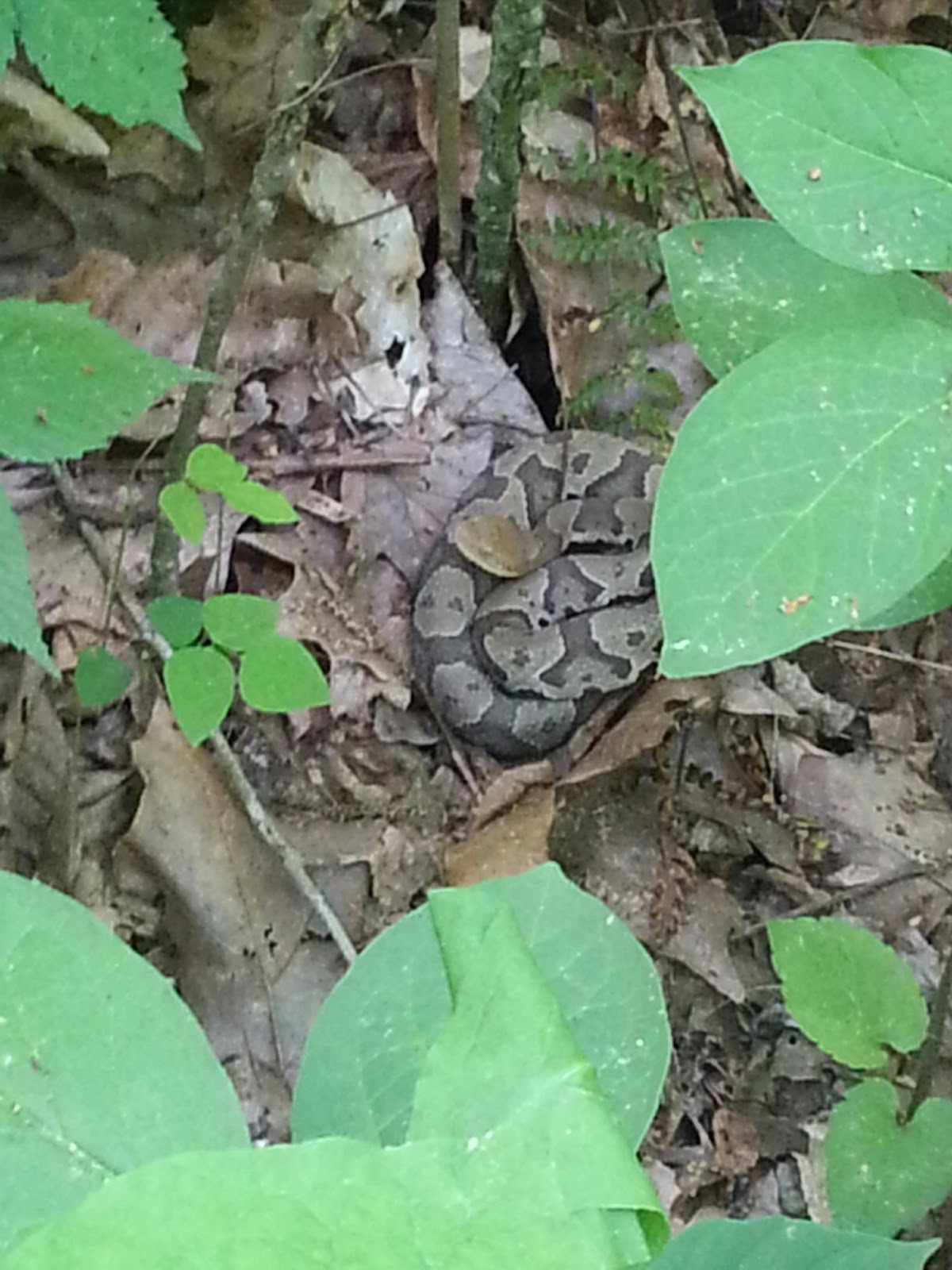
Do you see the copper head snake?  I had a hard time finding him, even when I was told he was there.


There it is!  This one has a nice copper colored head, so you can really tell what it is.  He was about three feet off the trail, and was very well behaved, even though we stopped to look and point.  
Related Posts Plugin for WordPress, Blogger...